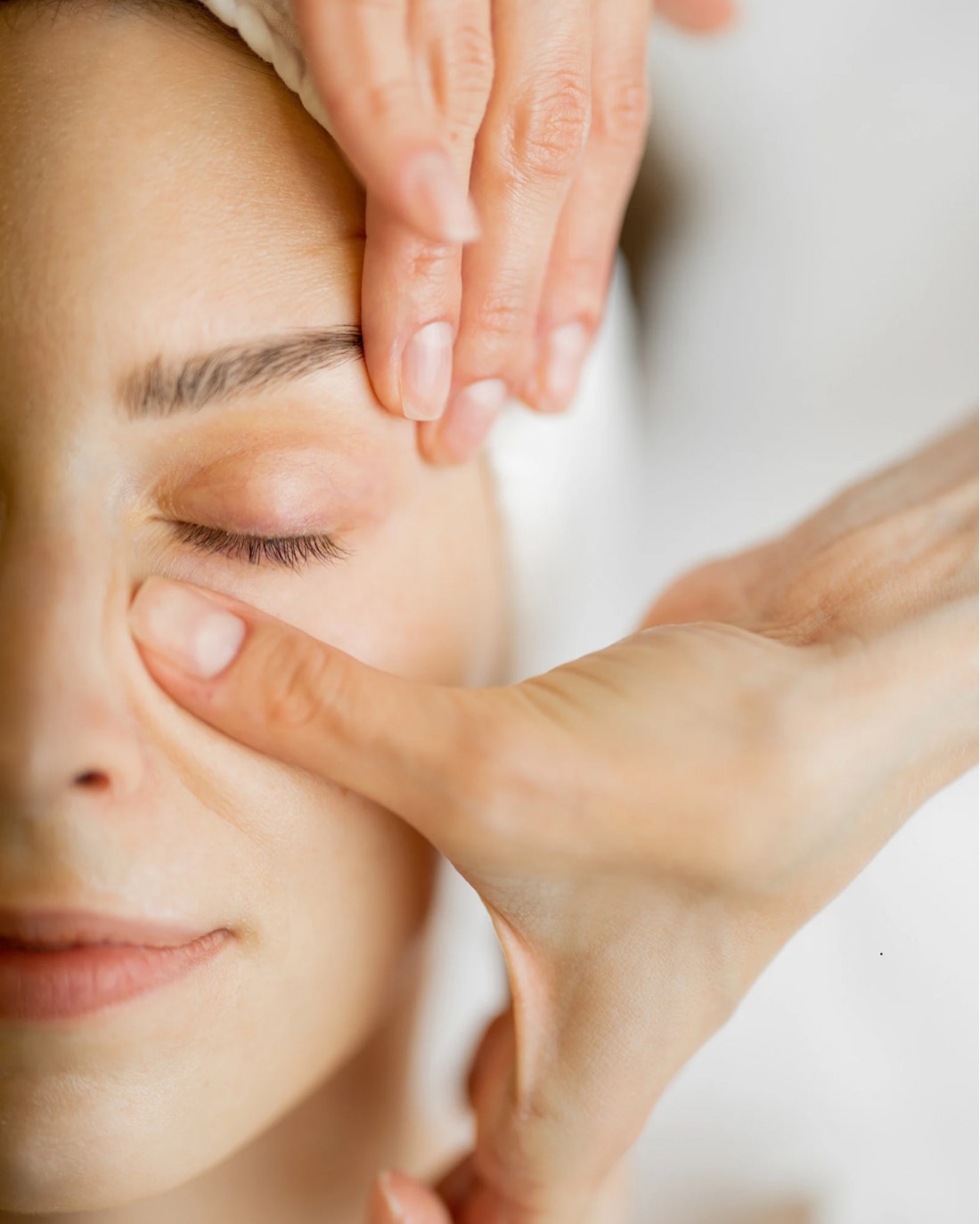
Before I learned any aesthetic technique, I studied anatomy the way medical students do — slowly, in detail, with respect. That is why facial massage never felt like a spa luxury to me. The face holds more than fifty muscles, layers of fascia, a dense lymphatic network and a lifetime of habits: clenched jaws, frowning at screens, sleeping on one side. Massage is simply a way of working with that anatomy directly, with trained hands.
What happens under the skin
Most facial muscles attach directly to the skin — unlike anywhere else in the body. When a muscle stays chronically shortened, the skin above it folds; when tissue fluid stagnates, the face looks puffy and heavy. Massage addresses both. Manual work measurably increases local blood flow, bringing oxygen and nutrients to skin that office life keeps slightly starved. Gentle, directed strokes move lymph toward its drainage points, which is why a well-done session visibly reduces morning puffiness and that grey, tired cast.
Buccal massage adds something no cream can reach: I work from inside the cheek, through the mouth, directly on the masseter and buccinator muscles. The masseter is one of the strongest muscles in the body relative to its size, and in people who clench or grind — which, in my experience, is most of us — it becomes dense, shortened and tender. Releasing it from the inside softens the lower face, eases jaw tightness and tension-type discomfort, and often improves the contour along the jawline, because a relaxed muscle simply sits differently than a clenched one.
Myofascial technique works on the connective tissue wrapping every muscle. Fascia can develop restrictions — areas where layers stop gliding smoothly. Slow, sustained pressure restores that glide. Patients describe the result as the face feeling lighter and more mobile, and expressions looking softer rather than fixed.
What the evidence honestly supports
I will not promise you a scalpel-free facelift, because that is not what massage is. The research we have shows improved microcirculation, reduced muscle tension and short-term lifting and de-puffing effects; studies on facial massage devices have documented increased blood flow and, with regular use over weeks, modest improvements in elasticity. The key word is regular. One session relaxes; a course retrains. Tension patterns built over decades respond to repetition, which is why I usually suggest a series followed by maintenance, much like physiotherapy for any other part of the body.
There is also a benefit nobody measures well but everyone feels: an hour when your face is touched skilfully and you are required to do absolutely nothing. Chronic stress shows on the face faster than age does. I take that part of the work seriously.
What massage will not do
It will not erase deep static wrinkles, lift significant sagging or replace sunscreen and a sensible skincare routine. It works best as part of a programme — alongside barrier care, peels or microcurrent — not as a miracle on its own. Anyone promising permanent structural change from massage alone is overselling.
What it will do, reliably, is this: release the tension you stopped noticing, restore circulation, reduce puffiness and give your face back its natural mobility. If your jaw aches by evening or your reflection looks heavier than you feel, a specialist's hands can usually tell you why within the first ten minutes.